
Some technical observations about the Space Adventure Cobra UK dub
I had an enjoyable evening watching Discotek's new blu-ray of the Manga UK dub of Space Adventure Cobra, with the Yello soundtrack. It's a pretty fun movie and I wrote a bit about it on letterboxd, as is my way. But I want to write about some observations I've made about the technical aspects of this dub of the film and such so that's what I'm going to do here.
I will now make a bunch of observations and then attempt to make sense of them.
The UK dub of Space Adventure Cobra, with the Yello soundtrack, was done to a 25fps copy of the film. This is pretty clear from the included songs, the only way they sound at the correct pitch and speed is if the film is played at 25fps. Which is not particularly unusual for a production done in the UK for video release, since that's kinda how PAL video works. Typically film runs at 24fps but when transferred to PAL video it was normally sped up to 25fps, to fit the 50hz video standard. So the conclusion is that the dub must have been mixed after the film was transferred to PAL video.
A lot of Manga UK's other releases worked off standards-converted NTSC masters, so there's no speed issues, but in this case they seem to have obtained a PAL transfer. This could indicate that they'd got the master on film and transferred it themselves, rather than receiving master tapes.
The original UK VHS of Cobra translates the opening credits rather crudely, with big black boxes obscuring the scary Japanese characters and English credits added to replace them. Discotek's new bluray does things a bit more tastefully, with the English credits in a nice serif font alongside the Japanese ones. But it's the original release where things get a bit interesting, because the credits for Yello's soundtrack are in a visibly different font to the others. Here's a comparison from a rip of the VHS I found online (I do own the VHS myself as well as the new discotek bluray, please excuse my current inability to transfer a VHS myself)
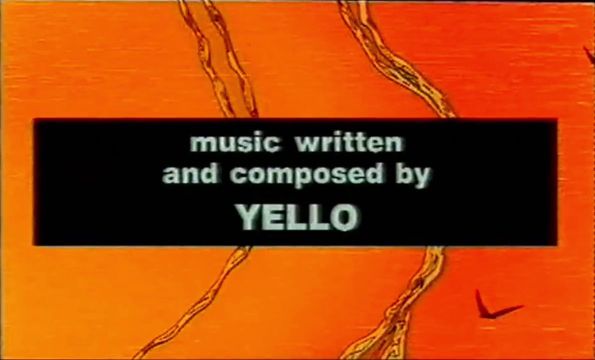
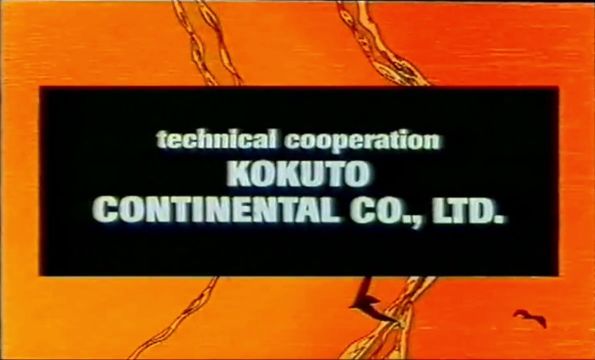
There's also some interesting things to observe in the end credits. The main credits crawl (done over a still image) includes all the usual credits as well as details of the dub cast and recording, but no mention of the music. After this crawl, there's a series of silent credit cards on a black background listing the credits and song publishing info for the Yello songs. The main credits crawl has a "produced on film" look to it, but the extra credits for the Yello songs look video-generated to me. On the Discotek bluray I suspect some of these may have been recreated as they look way too clean but I'm referring to the VHS rip too. I'm not sure what source Discotek used - some of their upscaled credits have some low-resolution compression artifacts, which makes me wonder if they used the one French DVD that actually included this dub as the cleanest source (or at least better than a VHS rip) but this doesn't matter too much for my ponderings here.
The wikipedia page for the movie does mention a UK theatrical run in 1995, citing an issue of a magazine called Film Review in 1995. Google Books won't let me see the full text of the page, just snips, but it does mention a release date of May 5 and the Yello soundtrack. The BBFC rating page does also mention a rating for theatrical showings.
As an aside, theatrical showings of films, even in countries that use PAL for their video standard, are generally still at the standard 24 frames per second. And the BBFC page backs this up with the theatrical runtime being significantly longer than the video runtime. (There's also a 2008 video rating running at a runtime closer to the theatrical one, this however would be the DVD release of the Streamline dub, standards-converted from NTSC)
So, you can probably see where I'm going with this. The sequencing of the Yello soundtrack was clearly done on a video master, because of the framerate. But it seems Manga had some of the dub materials prepared on film, and then they transferred this to video and then did the Yello music editing. Which raises some questions. Was there a version of this dub on a film print? Because there's certainly UK dub credits on a film print. Did they use the original soundtrack? If so, why does the Film Review article mention Yello? If not, why are all the Yello credits seemingly done as video edits, and why does the music run at PAL speeds?
I sort of set out to theorise that the film was dubbed and then reedited with the Yello soundtrack after the dub was finished, but the mentions of the theatrical run really mix things up further. Maybe Film Review were basing their review on a video screener? The home video rating on the BBFC site is about only a month after the theatrical rating, after all.
There's a bit of interview with Andy Frain on the blu-ray (that's partly taken from this larger interview that Justin Sevakis did for his Anime Business documentary, although I think some parts are exclusive to the blu-ray), where he talks about working out which track to place where on the film by basically just sitting down with the VHS.
Anyway, yeah there's been some forums consternation about this dub running at 25fps so it's been fresh in my mind and like I am the sort of person who notices what font credits are in so yeah. Was this film dubbed at 24fps as a film production and then resoundtracked at 25fps on video? idk maybe?
Also the credits apparently miscredit the voice of Cobra if you believe Wikipedia, so now I wonder what caused that too.